

Elversberg - Darmstadt 98 - live odds and in-play markets
What Elversberg - Darmstadt 98 is and where it runs
A top-up through Al Barid, Lbankalik or Cash Plus takes minutes, so the balance is ready before the first whistle. This page follows Elversberg - Darmstadt 98 from the first whistle to the last, and the board refreshes on its own while the ball is in play. The fixture belongs to Germany DFB Pokal, so the stage of that competition applies to this game too.
Squads are declared inside official windows; once the deadline passes the list freezes, and staff work with it until the next opening. The level of a competition decides how deep the in-play list runs. The entry filter gives it away — an event open to anyone who registers has nothing like the density of one where a place is earned on previous results. A meeting of Elversberg and Darmstadt 98 in a lower division opens fewer markets than a top-flight fixture, and the board shows only what is genuinely trading at that minute.
Head-to-head history sits beside the live board for a reason. A rivalry carries its own patterns, and the meetings these two have already played can tell you plenty, so it's worth a look before the whistle. Earlier meetings of Elversberg and Darmstadt 98 describe habits rather than outcomes, while the standings and the rest of the calendar stay on Germany DFB Pokal for anyone checking what this result changes.
Reading the board while the game runs


Under the scoreline sit the minute, the pressure counters and the price column. One tactical adjustment during the meeting, a fresh body brought in or a reshaped setup is enough to move the line, often before the effect shows on screen. A goal, a dismissal or a penalty award rewrites that column at once, so the number seen a second earlier is not the number the coupon accepts.
The board and the pattern of play sometimes tell opposite stories: figures measure territory, the score records only conversion, and the space between the two is where the reading happens. Reading a football match means watching where the ball spends its minutes, not only what the scoreline says. Withdrawing the star striker with the score level says plenty about the staff's priorities, as the fixture slips down the list and the closing stages read differently from that change on. Such turns arrive without warning, and the market answers before the crowd does.
How long the freeze lasts depends on what is being checked: a quick look reopens within seconds, while a heavier review keeps everything closed considerably longer. At the interval the list shrinks to the markets that survive a break and reopens when play restarts; a long stoppage for treatment or a video review does the same.
Live markets on this fixture
Good value often hides in the markets beyond the main result. The in-play list for football is built in layers: the result, then goals, then the small events that repeat dozens of times in a game. As soon as the calendar publishes a pairing, the base appears, often days ahead of the meeting, and stays open right up to the start without changing shape. Those base lines stay open almost from kick-off to the final whistle.
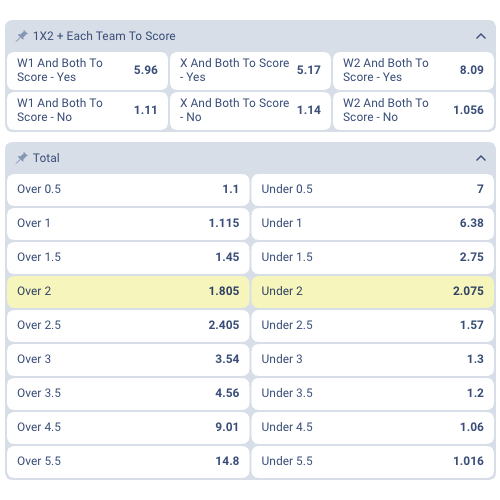
Every extra line is also a building block for a combined bet: a well-stocked sheet multiplies the assemblies possible across one round, provided each leg of the build is understood on its own. Depth follows coverage, so a widely tracked fixture opens corner and card lines that a quieter one never shows. The main markets cover the full-time result, double chance, Asian and European handicaps, and total goals over or under a set line. Alongside these you can back both teams to score, pick an exact correct score, or predict the half-time and full-time outcome, and any of them can be combined into an accumulator. The table below shows what each family settles on.
Market | What the bet covers | How it behaves in play |
|---|---|---|
1X2 live | A win for Elversberg, a draw, or a win for Darmstadt 98 from the current score | Reprices after every goal and every red card |
Total goals | Goals from both sides together, over or under the posted line | The line drops as the minutes run out |
Asian handicap | One side starts the coupon with a goal advantage | Moves as soon as the game turns one-sided |
Both teams to score | Whether Elversberg and Darmstadt 98 both find the net | Closes once the answer can no longer change |
Next goal | Which side scores next, or nobody does | Settles at the next goal or at the whistle |
Corners and cards | The count of corners or cards in a half or across the game | Runs while play continues, pauses at the break |
Correct score | The exact scoreline at the end of the match | Swings hardest in the seconds after a goal |
A generous price does not turn a poorly understood position into a good idea; it only shows that most bettors judge that scenario unlikely, which is a reason for caution. A market taken because it matches what is happening on the pitch lasts longer than one taken out of habit, and the lines above are read against the clock.
What moves the price right now
The whistle blows, a penalty is given, and a match that looked settled is wide open again — that is how quickly the next-goal and correct-score markets can swing, sometimes in a matter of seconds. Each of those turns reaches the coupon within seconds. Second halves bring more goals than first halves, between tiring legs, attacking substitutions and growing risk-taking, so a blank opening period proves little about the evening's total. One goal shifts the totals line, the handicap and the result price in the same refresh.
Tactical fouls do not fall evenly; they pile up on the side defending in transition, the one forced to stop counter-attacks at the very edge of what is allowed. A red card leaves a side a player short for the rest of the game, and the market treats the remaining minutes as a different match. The opening minutes are mostly about measuring each other, with compact blocks, few risks taken in one's own half, and a first period that seldom bursts open straight away. The two halves seldom carry the same rhythm, and the second is where the goal lines usually get decided.
On the last corner of a match slipping away, the goalkeeper walks up into the opposite box, and the danger runs both ways because the net behind him stands empty. Corners and free kicks near the area are the shortest route to a goal when a side cannot build through the middle. A coach still holding a window at the eightieth minute can answer an equaliser at once, while one who has spent everything can only rearrange what is already on the pitch. Fresh legs after the hour change the pressing distance, and the goal markets answer within a few minutes.
Match statistics: what they show and what they hide
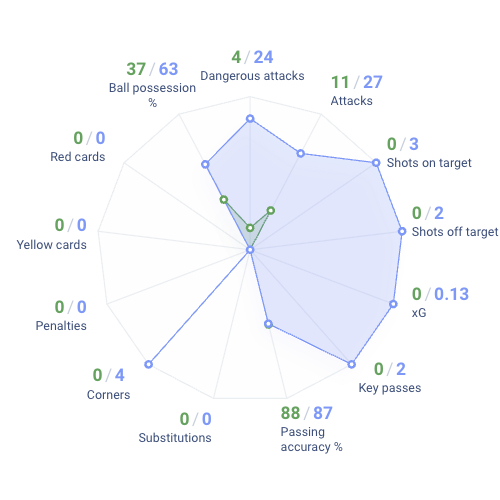
Head-to-head records age quickly: three seasons back, the table is describing two departed coaches, a rebuilt centre-back pairing and a squad that has since turned over. Possession, shots, shots on target, corners and dangerous attacks describe pressure, and pressure is what the goal markets price. Corner counts reward sides that cross often and sides chasing a scoreline late on, so the figure measures a style and a situation rather than dominance. A side can hold the ball for an hour without troubling the keeper, and the counter still reads in its favour.
The real examination of a stand-in goalkeeper happens on crosses and set pieces: coming out through a crowd, choosing between punching and catching, imposing himself on a zone full of bodies. One goalkeeper in form wipes out the gap the shot count promised. A handful of outings draws nothing solid. What repeats across a long stretch carries information, while what holds over only a few meetings stays noise. Recent form of Elversberg and Darmstadt 98 explains the opening prices, then loses weight with every minute the fixture actually plays.
Placing a bet while the game is live
System mode spreads the same picks across several combinations. The route is identical on a computer and on a phone.
Inside an opened match card, tabs sort the offer into families — main lines, totals, handicaps — and the market you are after turns up within a couple of taps. The football list in live football holds the fixture in place from kick-off to the final whistle.
Tap the price of the market you want. Two picks taken from the same meeting cannot sit together in an accumulator; the slip marks them as conflicting and waits until you keep just one. The coupon stores that figure as it stood at the tap.
Enter the stake in dirhams and check the return the coupon calculates.
In the label, '1' points to the side listed first and '2' to the other, nothing more; at a neutral-venue tournament that order names neither the favourite nor the host. A price that moved while you were typing comes back for acceptance instead of being swapped in silently.
Follow the ticket in the list of open bets, where settlement appears once the result is official.
Where the option is offered, a running bet can be closed early for the sum shown at that moment, a judgement about the minutes still to come rather than the final score.
Prematch and live on the same fixture
Choosing your own moment stays possible while nothing has started: you come in when the price suits you. Live, the flow of the meeting sets the tempo instead. The prematch line opens days ahead on the football line and closes the moment the referee starts play. The full board is visible in advance, side markets included, and several close the moment play starts; going through them without hurry is part of the pre-match work. A price taken early carries the risk of team news; one taken in play carries the risk of the next attack.
Live betting earns its place when the play contradicts the forecast, since an injury, an exclusion or a change of plan reopens the contest. A position opened before kick-off and an addition made twenty minutes in can sit in the same ticket list. When a penalty is given or a video check begins, markets freeze for a few moments and reopen at rebuilt prices; those pauses belong to the rhythm of in-play and reward whoever expects them. The board stays open to the last action, and the rest of the live section works on the same clock for every other sport in play.
Money, app and help in Morocco
Deposits start inside the account area, in the cashier section, where the list shown is already limited to what actually works for players in Morocco. An account held in Morocco is funded and settled in dirhams, so no conversion stands between the deposit and the stake. With Lbankalik the whole route fits in the phone — the request is filed online and the account checked in the app, with no branch visit anywhere. A withdrawal is requested from the same cashier screen, which lists the methods open for it at that moment.
Method | What it is | Currency | Suits a bettor who |
|---|---|---|---|
CIH | Moroccan bank, cards and transfers | MAD | already banks there and pays from the banking app |
Attijari | Moroccan banking network with branches nationwide | MAD | holds a card from the same group |
Al Barid | Postal banking service | MAD | uses the post office network every day |
Lbankalik | Everyday Moroccan banking service | MAD | handles the account mostly from a phone |
Cash Plus | Cash payment network with staffed counters | MAD | pays in notes at a counter, without a card |
Deposits start inside the app itself, through familiar Moroccan channels such as CIH, Attijari or Cash Plus, with no browser involved. A phone left on the fixture screen shows the same prices as a computer, and the mobile app page sets out what the download asks for. Add a championship to favourites and its fixtures open first every time. A goal alert lands faster than a manual refresh, which decides whether a market is still open when you reach it.
Listing what has already been tried, a reload, another browser, logging back in, spares the agent the opening checklist and starts the exchange one step further along. A stake that did not go through is easiest to raise from inside the account, where the ticket carries its own number. If a deposit does not go through as expected, the team looks into it with you and explains exactly what to check on your side. The reply arrives in the same window, and the thread keeps the history.
After the final whistle
A glance at the calendar early in the week is enough to see which days are taken, and it stops you from spotting an awaited fixture only after it has been played. Settlement runs against the official result, and the ticket moves from the open list into the history. Nothing has to be confirmed during the visit; going through the section just to see how it is arranged counts as a use of its own. The competition carries on, and the next round for Elversberg and Darmstadt 98 appears on the same list within hours.
Every weekend brings a new card, from the Moroccan championship to the major European leagues. A game still in play keeps its board alive to the last kick, and the list rolls on to the next kick-off as soon as this one closes.