

Perla Zlotoklos II - Ursus Warszawa III - live odds and in-play markets
What Perla Zlotoklos II - Ursus Warszawa III is and where it runs
An opening price rarely survives untouched, tightening or drifting as news and money come in. This page follows Perla Zlotoklos II - Ursus Warszawa III from the first whistle to the last, and the board refreshes on its own while the ball is in play. The fixture belongs to Poland. Region League, so the stage of that competition applies to this game too.
Venues are not negotiable either: the organiser allocates sites, alternates hosting or draws lots, and entrants learn their programme at the same moment as the public does. The level of a competition decides how deep the in-play list runs. Check the category before anything else — youth, second-string entrants, amateurs, elite. Two events can carry nearly identical names and still be worlds apart in practice. A meeting of Perla Zlotoklos II and Ursus Warszawa III in a lower division opens fewer markets than a top-flight fixture, and the board shows only what is genuinely trading at that minute.
Head-to-head history sits beside the live board for a reason. The goal counts from their recent duels point toward the totals market far more than toward the 1X2 line. Earlier meetings of Perla Zlotoklos II and Ursus Warszawa III describe habits rather than outcomes, while the standings and the rest of the calendar stay on Poland. Region League for anyone checking what this result changes.
Reading the board while the game runs


Under the scoreline sit the minute, the pressure counters and the price column. The totals market follows the scoring rhythm and can slide while the winner price barely moves, because two neighbouring lines answer to different signals. A goal, a dismissal or a penalty award rewrites that column at once, so the number seen a second earlier is not the number the coupon accepts.
The stream always runs a few seconds behind the venue, so when a price lurches with nothing visible on screen, the cause already exists — it simply has not been shown yet. Reading a football match means watching where the ball spends its minutes, not only what the scoreline says. A trailing side pushing its defenders forward leaves space behind, so the next-goal market tightens in its favour while quietly getting more generous for the team countering. Such turns arrive without warning, and the market answers before the crowd does.
The closer the finish, the more often the freezes come: every attack now weighs directly on the outcome, so the market locks at each alert rather than risk a wrong price. At the interval the list shrinks to the markets that survive a break and reopens when play restarts; a long stoppage for treatment or a video review does the same.
Live markets on this fixture
Good value often hides in the markets beyond the main result. The in-play list for football is built in layers: the result, then goals, then the small events that repeat dozens of times in a game. Opening rounds receive the same base as the decisive meetings; the stage of the competition changes what surrounds that core, never the core itself. Those base lines stay open almost from kick-off to the final whistle.
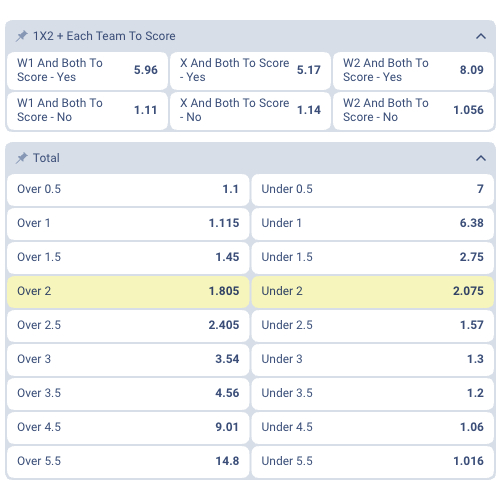
A short sheet does not mean a neglected meeting; the market simply has less material to slice and would rather offer little than post lines it cannot price properly. Depth follows coverage, so a widely tracked fixture opens corner and card lines that a quieter one never shows. Each team carries its own totals too — its individual goal count, winning at least one of the two halves, or scoring in both. These markets isolate one camp's output without depending on what the opponent produces. The table below shows what each family settles on.
Market | What the bet covers | How it behaves in play |
|---|---|---|
1X2 live | A win for Perla Zlotoklos II, a draw, or a win for Ursus Warszawa III from the current score | Reprices after every goal and every red card |
Total goals | Goals from both sides together, over or under the posted line | The line drops as the minutes run out |
Asian handicap | One side starts the coupon with a goal advantage | Moves as soon as the game turns one-sided |
Both teams to score | Whether Perla Zlotoklos II and Ursus Warszawa III both find the net | Closes once the answer can no longer change |
Next goal | Which side scores next, or nobody does | Settles at the next goal or at the whistle |
Corners and cards | The count of corners or cards in a half or across the game | Runs while play continues, pauses at the break |
Correct score | The exact scoreline at the end of the match | Swings hardest in the seconds after a goal |
In fixtures with outsized stakes the logic of the table weakens, and markets built on it, the outcome first among them, give way to lines less tied to hierarchy. A market taken because it matches what is happening on the pitch lasts longer than one taken out of habit, and the lines above are read against the clock.
What moves the price right now
A goal inside the opening quarter of an hour redraws the match: the side in front drops a line deeper, the other pushes up, and the space that appears feeds the next-goal market as much as the over. Each of those turns reaches the coupon within seconds. The opening goal settles half of the both-teams-to-score question, and the rest hangs on whether the side behind still keeps a genuine attacking route forward. One goal shifts the totals line, the handicap and the result price in the same refresh.
Every card freezes play for a moment, protest, a wall to set, tempers to cool, so matches broken up by sanctions spill into long added time, the familiar window for late goals. A red card leaves a side a player short for the rest of the game, and the market treats the remaining minutes as a different match. The interval breaks rhythms; a side that had the match by the collar can come back flat, while the other one has had time to breathe and reorganise itself. The two halves seldom carry the same rhythm, and the second is where the goal lines usually get decided.
Corner counts follow style rather than the scoreline; a team attacking through the flanks racks them up even while losing, simply because it keeps putting balls into the box. Corners and free kicks near the area are the shortest route to a goal when a side cannot build through the middle. Every change cuts the rhythm: the side that was pushing stops, the other one breathes and resets its lines, and a wave that was building falls away with nothing to show. Fresh legs after the hour change the pressing distance, and the goal markets answer within a few minutes.
Match statistics: what they show and what they hide
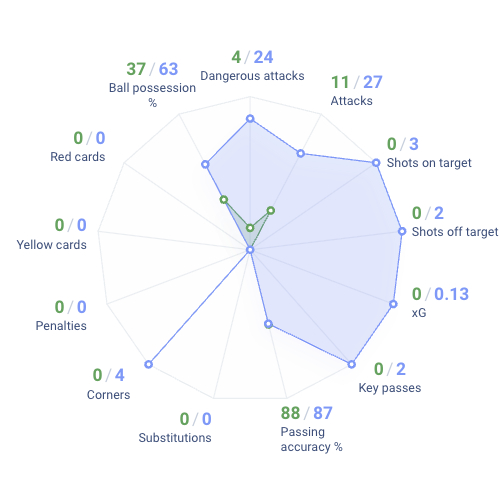
A goals-per-game figure only compares inside its own league: tempo, refereeing and the distance between top and bottom differ from one competition to the next. Possession, shots, shots on target, corners and dangerous attacks describe pressure, and pressure is what the goal markets price. A disciplinary table describes referees as much as players. Depending on who is whistling, the same contact ends up in a notebook or in a quiet free-kick nobody remembers. A side can hold the ball for an hour without troubling the keeper, and the counter still reads in its favour.
A reserve keeper often arrives after months without a competitive minute. Match rhythm cannot be rehearsed in training, and his first hot intervention is also his first real action in a long while. One goalkeeper in form wipes out the gap the shot count promised. The immediate schedule matters as much as momentum does; between one competitor arriving off a midweek trip and another coming in rested, the freshness gap shows from the opening minutes. Recent form of Perla Zlotoklos II and Ursus Warszawa III explains the opening prices, then loses weight with every minute the fixture actually plays.
Placing a bet while the game is live
The search field reaches a fixture faster than the sport tree. The route is identical on a computer and on a phone.
A finished meeting drops out of the betting list altogether, and its final score is looked up in the results section, which keeps the outcome of every completed matchday. The football list in live football holds the fixture in place from kick-off to the final whistle.
Tap the price of the market you want. In singles mode every line carries its own stake, and a missed call leaves the rest of the slip untouched. The coupon stores that figure as it stood at the tap.
Enter the stake in dirhams and check the return the coupon calculates.
Two positions taken from the same fixture do not always combine, and the slip flags the clash before validation — sorting it out there beats running into a refusal. A price that moved while you were typing comes back for acceptance instead of being swapped in silently.
Follow the ticket in the list of open bets, where settlement appears once the result is official.
Where the option is offered, a running bet can be closed early for the sum shown at that moment, a judgement about the minutes still to come rather than the final score.
Prematch and live on the same fixture
The mid-match break is a compromise between the two worlds: the board fills out again, prices settle, and the decision leans on a full period actually watched. The prematch line opens days ahead on the football line and closes the moment the referee starts play. Pre-match time is also for matching the market to your actual read — expecting a cagey, locked meeting points to the totals rather than the winner. A price taken early carries the risk of team news; one taken in play carries the risk of the next attack.
Pick the moment that suits your read of the match. A position opened before kick-off and an addition made twenty minutes in can sit in the same ticket list. When a penalty is given or a video check begins, markets freeze for a few moments and reopen at rebuilt prices; those pauses belong to the rhythm of in-play and reward whoever expects them. The board stays open to the last action, and the rest of the live section works on the same clock for every other sport in play.
Money, app and help in Morocco
The holder of the payment instrument and the holder of the account have to be the same person, and even a small spelling gap in the name is enough to hold the credit up. An account held in Morocco is funded and settled in dirhams, so no conversion stands between the deposit and the stake. Reading the details over before sending saves trouble, since one transposed digit sends the payment back where it started and the whole thing has to be redone. A withdrawal is requested from the same cashier screen, which lists the methods open for it at that moment.
Method | What it is | Currency | Suits a bettor who |
|---|---|---|---|
CIH | Moroccan bank, cards and transfers | MAD | already banks there and pays from the banking app |
Attijari | Moroccan banking network with branches nationwide | MAD | holds a card from the same group |
Al Barid | Postal banking service | MAD | uses the post office network every day |
Lbankalik | Everyday Moroccan banking service | MAD | handles the account mostly from a phone |
Cash Plus | Cash payment network with staffed counters | MAD | pays in notes at a counter, without a card |
Alerts can be filtered down to the competitions you actually follow and switched off everywhere else, something a browser tab has no way of offering. A phone left on the fixture screen shows the same prices as a computer, and the mobile app page sets out what the download asks for. Install the mobile app and keep every match within reach. A goal alert lands faster than a manual refresh, which decides whether a market is still open when you reach it.
One question per ticket works better, since mixing several topics sends the case off to different teams and pushes the answer further away. A stake that did not go through is easiest to raise from inside the account, where the ticket carries its own number. New players are never left on their own: the support staff walks you through the first steps, from setting up an account to placing an early bet. The reply arrives in the same window, and the thread keeps the history.
After the final whistle
Sorting by date puts the calendar back in order, and a single look shows which meetings come first and which ones will wait until the end of the week. Settlement runs against the official result, and the ticket moves from the open list into the history. The same section exists in French, English and Arabic; fixtures and odds stay identical from one version to the next, and only the display language differs. The competition carries on, and the next round for Perla Zlotoklos II and Ursus Warszawa III appears on the same list within hours.
Kickoff is just moments away. A game still in play keeps its board alive to the last kick, and the list rolls on to the next kick-off as soon as this one closes.