

Rostov - Krasnodar - live odds and in-play markets
What Rostov - Krasnodar is and where it runs
Waiting for a major clash sharpens every sense, as each figure and each detail suddenly gains weight. This page follows Rostov - Krasnodar from the first whistle to the last, and the board refreshes on its own while the ball is in play. The fixture belongs to Russia. Premier League, so the stage of that competition applies to this game too.
The regulations always provide a resolution, since some pre-written mechanism, tie-breakers, play-offs or a final, leaves a single winner at the end of the programme. The level of a competition decides how deep the in-play list runs. How early the prices go up is a quiet indicator: a major competition is posted weeks ahead, a secondary one shows up the day before. A meeting of Rostov and Krasnodar in a lower division opens fewer markets than a top-flight fixture, and the board shows only what is genuinely trading at that minute.
Head-to-head history sits beside the live board for a reason. Some pairings keep producing the same type of outcome, and that frequency makes the matching price deserve a second look. Earlier meetings of Rostov and Krasnodar describe habits rather than outcomes, while the standings and the rest of the calendar stay on Russia. Premier League for anyone checking what this result changes.
Reading the board while the game runs
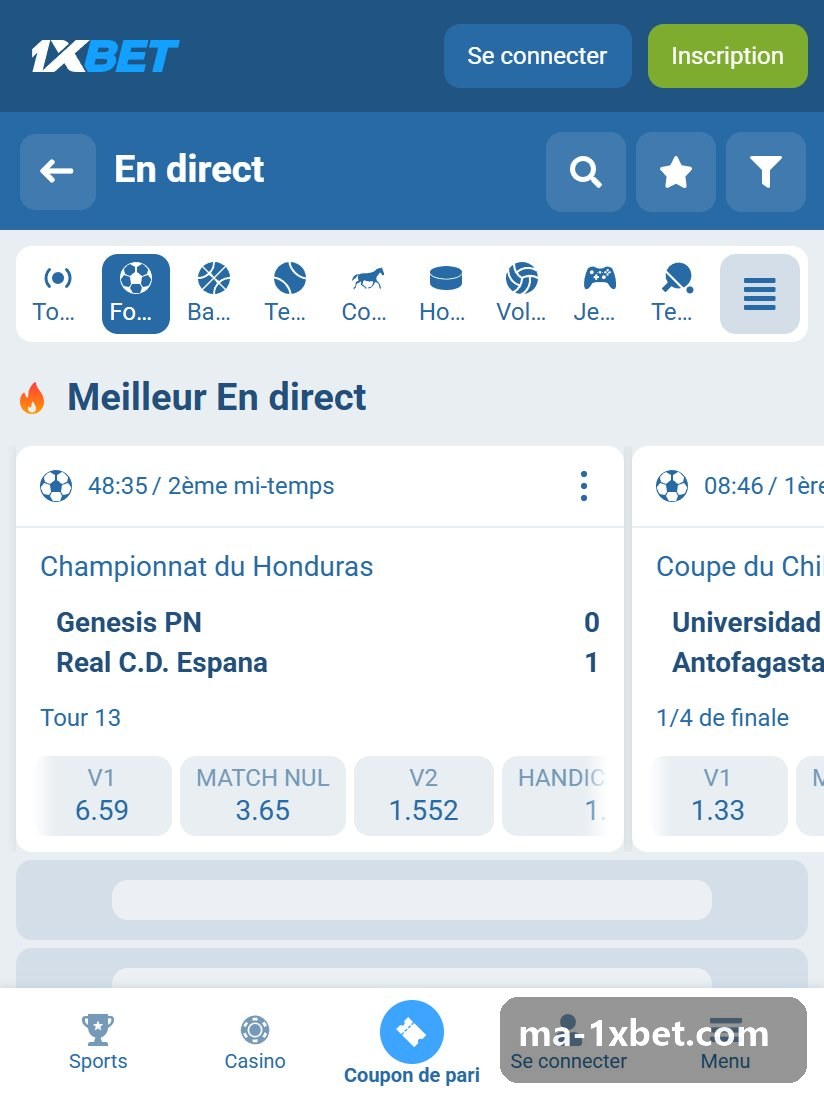

Under the scoreline sit the minute, the pressure counters and the price column. Sustained pressure without reward still counts: when one side strings together favourable sequences, the price drifts steadily long before the situation actually turns. A goal, a dismissal or a penalty award rewrites that column at once, so the number seen a second earlier is not the number the coupon accepts.
The board and the pattern of play sometimes tell opposite stories: figures measure territory, the score records only conversion, and the space between the two is where the reading happens. Reading a football match means watching where the ball spends its minutes, not only what the scoreline says. The bench speaks before the scoreboard: bringing on an extra forward, or an extra defender instead, signals the coach's intent well before the market has fully priced it. Such turns arrive without warning, and the market answers before the crowd does.
How long the freeze lasts depends on what is being checked: a quick look reopens within seconds, while a heavier review keeps everything closed considerably longer. At the interval the list shrinks to the markets that survive a break and reopens when play restarts; a long stoppage for treatment or a video review does the same.
Live markets on this fixture
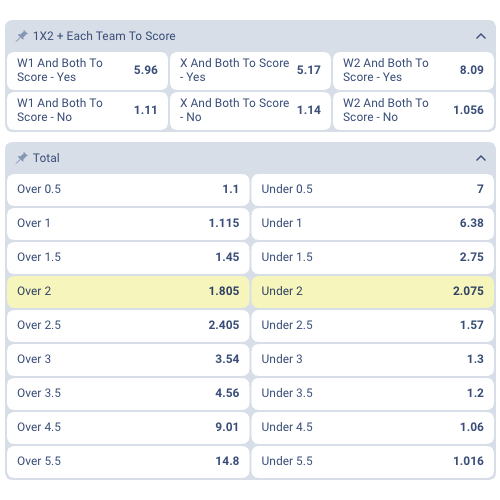
Combined markets join two conditions in one selection and pay a higher price for that extra demand. The in-play list for football is built in layers: the result, then goals, then the small events that repeat dozens of times in a game. Most tickets on the tournament land on these few positions, which keeps them under constant correction and leaves little room for a mispriced line to survive very long. Those base lines stay open almost from kick-off to the final whistle.
A longer list carries no extra knowledge: the side positions all derive from the same core and restate, cut differently, the same starting estimate. Depth follows coverage, so a widely tracked fixture opens corner and card lines that a quieter one never shows. A typical page offers the result, handicaps and totals, plus the exact score where the sport allows it. Add bets on a single period and a selection of player or team props, and all of it can be linked in one accumulator. The table below shows what each family settles on.
Market | What the bet covers | How it behaves in play |
|---|---|---|
1X2 live | A win for Rostov, a draw, or a win for Krasnodar from the current score | Reprices after every goal and every red card |
Total goals | Goals from both sides together, over or under the posted line | The line drops as the minutes run out |
Asian handicap | One side starts the coupon with a goal advantage | Moves as soon as the game turns one-sided |
Both teams to score | Whether Rostov and Krasnodar both find the net | Closes once the answer can no longer change |
Next goal | Which side scores next, or nobody does | Settles at the next goal or at the whistle |
Corners and cards | The count of corners or cards in a half or across the game | Runs while play continues, pauses at the break |
Correct score | The exact scoreline at the end of the match | Swings hardest in the seconds after a goal |
Wanting a particular participant to come through is not information; it shortens the analysis and pushes toward the line that feels good instead of the one that fits the facts. A market taken because it matches what is happening on the pitch lasts longer than one taken out of habit, and the lines above are read against the clock.
What moves the price right now
Heavy rain and a soaked pitch slow everything down: passes get stuck, chances turn scrappy, play piles up near the corner flags — a scenario that quietly favours the corners and the under. Each of those turns reaches the coupon within seconds. Conceding at home changes the mood in the stands, the crowd hurries its own players, and a controlled performance turns into a rushed one within a few passes. One goal shifts the totals line, the handicap and the result price in the same refresh.
Being a man up rarely makes a game wild; the full side slows the ball, switches it from flank to flank and probes, stretching the match out rather than blowing it open. A red card leaves a side a player short for the rest of the game, and the market treats the remaining minutes as a different match. At the interval a separate set of second-half lines opens and starts again from nil-nil, where the first act's score no longer counts and only what remains to be played is priced. The two halves seldom carry the same rhythm, and the second is where the goal lines usually get decided.
Corner counts follow style rather than the scoreline; a team attacking through the flanks racks them up even while losing, simply because it keeps putting balls into the box. Corners and free kicks near the area are the shortest route to a goal when a side cannot build through the middle. Every change cuts the rhythm: the side that was pushing stops, the other one breathes and resets its lines, and a wave that was building falls away with nothing to show. Fresh legs after the hour change the pressing distance, and the goal markets answer within a few minutes.
Match statistics: what they show and what they hide
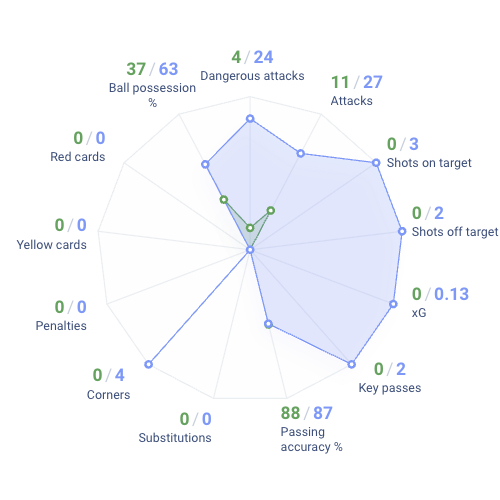
A goals-per-game figure only compares inside its own league: tempo, refereeing and the distance between top and bottom differ from one competition to the next. Possession, shots, shots on target, corners and dangerous attacks describe pressure, and pressure is what the goal markets price. Charts splitting goals into fifteen-minute bands inflate the last one mechanically, because it swallows stoppage time, and every team ends up looking like a late scorer. A side can hold the ball for an hour without troubling the keeper, and the counter still reads in its favour.
The real examination of a stand-in goalkeeper happens on crosses and set pieces: coming out through a crowd, choosing between punching and catching, imposing himself on a zone full of bodies. One goalkeeper in form wipes out the gap the shot count promised. Momentum built in one environment needs rechecking once the setting changes, because a different surface, climate or altitude wears down old certainties. Recent form of Rostov and Krasnodar explains the opening prices, then loses weight with every minute the fixture actually plays.
Placing a bet while the game is live
Beginners and seasoned players alike find the process intuitive. The route is identical on a computer and on a phone.
A date filter narrows the display to the day you picked, handy when the competition spreads its programme over several days and only one evening interests you. The football list in live football holds the fixture in place from kick-off to the final whistle.
Tap the price of the market you want. While an accumulator is still running, the history breaks it down leg by leg: settled picks are marked and the pending ones listed next to their fixtures. The coupon stores that figure as it stood at the tap.
Enter the stake in dirhams and check the return the coupon calculates.
Without a balance large enough to cover the stake, validation stops dead, and checking that beforehand beats discovering the block at the very moment you press. A price that moved while you were typing comes back for acceptance instead of being swapped in silently.
Follow the ticket in the list of open bets, where settlement appears once the result is official.
Where the option is offered, a running bet can be closed early for the sum shown at that moment, a judgement about the minutes still to come rather than the final score.
Prematch and live on the same fixture
Accumulators come together comfortably before the start, pick by pick across several days, whereas live lines suspend too often for a slip to be built in peace. The prematch line opens days ahead on the football line and closes the moment the referee starts play. Nothing forces a decision today. The stretch before a fixture is also there for skipping one that says nothing to you and keeping the stake for another meeting. A price taken early carries the risk of team news; one taken in play carries the risk of the next attack.
A position taken the day before can sit alongside a live stake placed on a different market of the same game. A position opened before kick-off and an addition made twenty minutes in can sit in the same ticket list. In-play football makes every attack matter, as odds rise and fall with each shot and counterattack. The board stays open to the last action, and the rest of the live section works on the same clock for every other sport in play.
Money, app and help in Morocco
Deposits start inside the account area, in the cashier section, where the list shown is already limited to what actually works for players in Morocco. An account held in Morocco is funded and settled in dirhams, so no conversion stands between the deposit and the stake. Once the status turns to executed, the funds have already left; whatever time remains belongs to the receiving institution and gets checked on that side. A withdrawal is requested from the same cashier screen, which lists the methods open for it at that moment.
Method | What it is | Currency | Suits a bettor who |
|---|---|---|---|
CIH | Moroccan bank, cards and transfers | MAD | already banks there and pays from the banking app |
Attijari | Moroccan banking network with branches nationwide | MAD | holds a card from the same group |
Al Barid | Postal banking service | MAD | uses the post office network every day |
Lbankalik | Everyday Moroccan banking service | MAD | handles the account mostly from a phone |
Cash Plus | Cash payment network with staffed counters | MAD | pays in notes at a counter, without a card |
Sections stay loaded on the device, so moving from one competition to another happens without the blank pause that a full page reload brings. A phone left on the fixture screen shows the same prices as a computer, and the mobile app page sets out what the download asks for. Install the mobile app and keep every event within reach. A goal alert lands faster than a manual refresh, which decides whether a market is still open when you reach it.
Naming the exact moment the problem happened helps the matching record surface, as a whole day stays far too wide a window to search through. A stake that did not go through is easiest to raise from inside the account, where the ticket carries its own number. Questions are usually handled without a long wait: the advisers reply promptly and follow the case until it is fully resolved. The reply arrives in the same window, and the thread keeps the history.
After the final whistle
Adding the competition to your favourites pins it at the top of the menu, so the next visit opens on it directly instead of the full list of sports. Settlement runs against the official result, and the ticket moves from the open list into the history. If a question is still hanging after these lines, the answer usually sits on the page itself, on the row of the meeting concerned. The competition carries on, and the next round for Rostov and Krasnodar appears on the same list within hours.
Don't let the excitement pass you by. A game still in play keeps its board alive to the last kick, and the list rolls on to the next kick-off as soon as this one closes.