

Kazakh National University of Sport - AIU - live odds and in-play markets
What Kazakh National University of Sport - AIU is and where it runs
Waiting for a major clash sharpens every sense, as each figure and each detail suddenly gains weight. This page follows Kazakh National University of Sport - AIU from the first whistle to the last, and the board refreshes on its own while the ball is in play. The fixture belongs to Kazakhstan. Student League, so the stage of that competition applies to this game too.
Preparation is built around this appointment, from training loads and rest windows to which secondary events to skip, and the rest of the year is arranged to fit around it. The level of a competition decides how deep the in-play list runs. Preparation events staged before the season opens exist to tune the machine: participants test things rather than chase the result, and the winner tells you little about the real pecking order. A meeting of Kazakh National University of Sport and AIU in a lower division opens fewer markets than a top-flight fixture, and the board shows only what is genuinely trading at that minute.
Head-to-head history sits beside the live board for a reason. Every rivalry develops its own habits, and the duels already played between these two say a lot, so a quick look before the start is time well spent. Earlier meetings of Kazakh National University of Sport and AIU describe habits rather than outcomes, while the standings and the rest of the calendar stay on Kazakhstan. Student League for anyone checking what this result changes.
Reading the board while the game runs
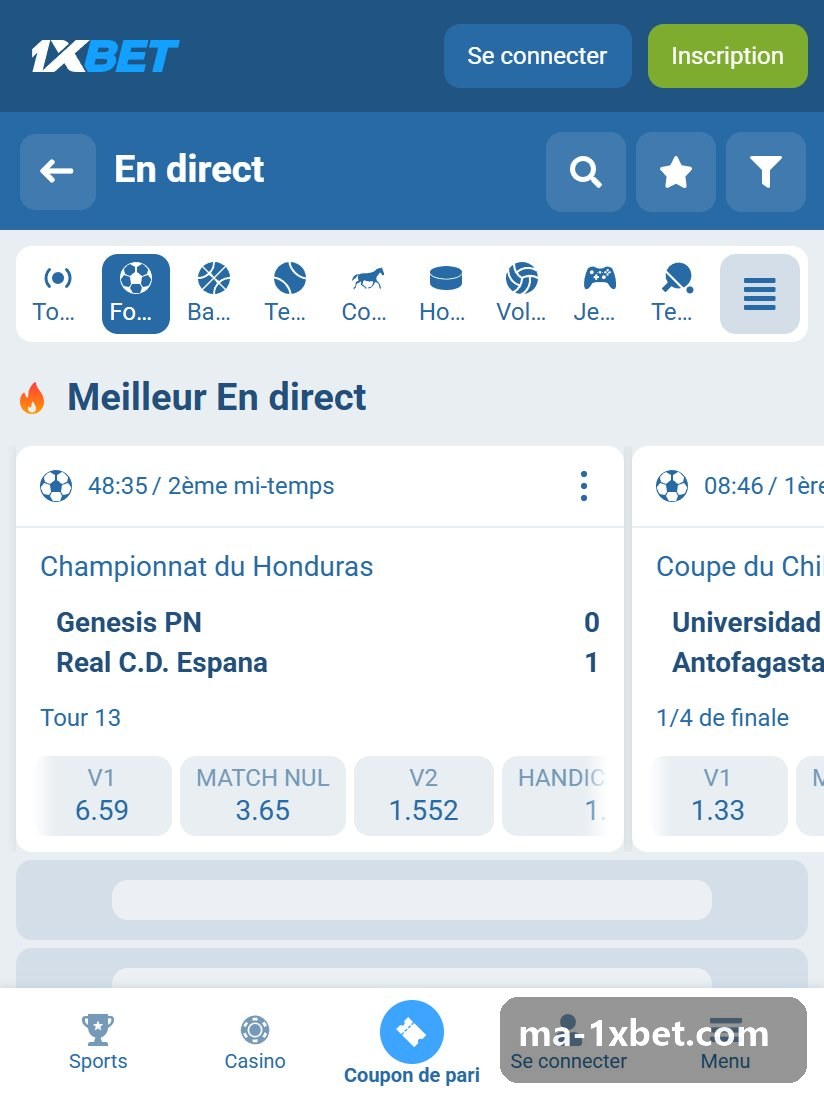

Under the scoreline sit the minute, the pressure counters and the price column. Movement comes in steps rather than a smooth curve: the line sits still, jumps, then freezes again, because information reaches the book in bursts. A goal, a dismissal or a penalty award rewrites that column at once, so the number seen a second earlier is not the number the coupon accepts.
Commitment in neutral situations, the contests that belong to nobody, betrays intent: the side snapping them up declares itself long before the score confirms anything. Reading a football match means watching where the ball spends its minutes, not only what the scoreline says. A sending-off often moves the price more than a goal: the short-handed side drops deep, gives up the ball, and handicap and goal lines are rewritten straight away. Such turns arrive without warning, and the market answers before the crowd does.
Suspension appears while an episode is still unresolved, and the site would rather close for a moment than keep selling a price that reality has already overtaken. At the interval the list shrinks to the markets that survive a break and reopens when play restarts; a long stoppage for treatment or a video review does the same.
Live markets on this fixture
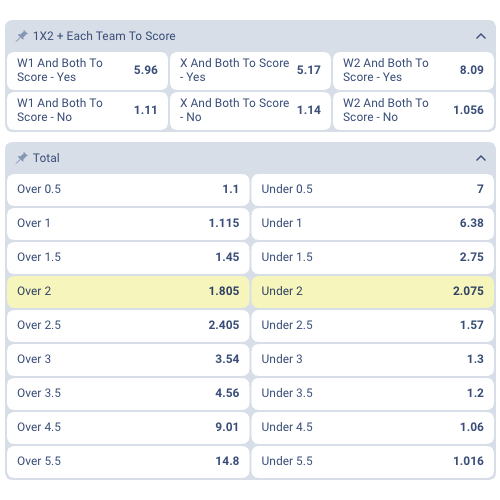
One match can be approached in dozens of different ways. The in-play list for football is built in layers: the result, then goals, then the small events that repeat dozens of times in a game. A full day of competition can be covered from this base alone, without opening the detailed sheet, which makes it the quickest format to scan when fixtures come one after another. Those base lines stay open almost from kick-off to the final whistle.
A short sheet does not mean a neglected meeting; the market simply has less material to slice and would rather offer little than post lines it cannot price properly. Depth follows coverage, so a widely tracked fixture opens corner and card lines that a quieter one never shows. Sharper lines cover the exact total, whether the total is odd or even, or a winning margin within a set range. They pay better than the main markets, in exchange for a precision that only the full course of the meeting can validate. The table below shows what each family settles on.
Market | What the bet covers | How it behaves in play |
|---|---|---|
1X2 live | A win for Kazakh National University of Sport, a draw, or a win for AIU from the current score | Reprices after every goal and every red card |
Total goals | Goals from both sides together, over or under the posted line | The line drops as the minutes run out |
Asian handicap | One side starts the coupon with a goal advantage | Moves as soon as the game turns one-sided |
Both teams to score | Whether Kazakh National University of Sport and AIU both find the net | Closes once the answer can no longer change |
Next goal | Which side scores next, or nobody does | Settles at the next goal or at the whistle |
Corners and cards | The count of corners or cards in a half or across the game | Runs while play continues, pauses at the break |
Correct score | The exact scoreline at the end of the match | Swings hardest in the seconds after a goal |
In fixtures with outsized stakes the logic of the table weakens, and markets built on it, the outcome first among them, give way to lines less tied to hierarchy. A market taken because it matches what is happening on the pitch lasts longer than one taken out of habit, and the lines above are read against the clock.
What moves the price right now
The scoreboard reads the same after a saved penalty, yet everything else shifts: the keeper who pushes it away lifts his team, the player who missed starts passing sideways, and the next goal often changes ends. Each of those turns reaches the coupon within seconds. The second goal changes what the match is, since a two-goal lead turns the leader into a manager of the game, and comebacks from that far back stay rare. One goal shifts the totals line, the handicap and the result price in the same refresh.
A foul inside the area punished with both a penalty and a red turns a match on a single action: a goal all but given, and a man missing until the final whistle. A red card leaves a side a player short for the rest of the game, and the market treats the remaining minutes as a different match. The interval breaks rhythms; a side that had the match by the collar can come back flat, while the other one has had time to breathe and reorganise itself. The two halves seldom carry the same rhythm, and the second is where the goal lines usually get decided.
A marking flaw does not repair itself during play: if the first corner found the hole in a zonal set-up, the ones that follow will find it too. Corners and free kicks near the area are the shortest route to a goal when a side cannot build through the middle. A coach still holding a window at the eightieth minute can answer an equaliser at once, while one who has spent everything can only rearrange what is already on the pitch. Fresh legs after the hour change the pressing distance, and the goal markets answer within a few minutes.
Match statistics: what they show and what they hide
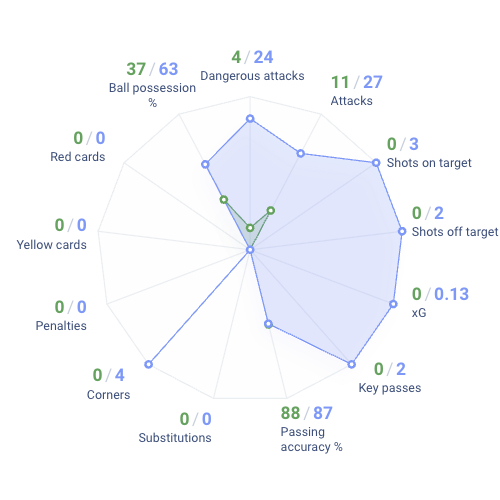
A team's averages were collected with a given squad on the pitch. A first-choice goalkeeper out, or a holding midfielder suspended, changes the very thing those numbers describe. Possession, shots, shots on target, corners and dangerous attacks describe pressure, and pressure is what the goal markets price. A scoring run looks impressive mainly when you ignore who stood opposite. More often than not it describes the order of opponents faced rather than any real jump in level. A side can hold the ball for an hour without troubling the keeper, and the counter still reads in its favour.
At corners everything rests on trust that cannot be improvised: defenders need to know which ball their goalkeeper will come for and which one he leaves to them, and that understanding takes weeks to settle. One goalkeeper in form wipes out the gap the shot count promised. A run is worth only as much as the opponents inside it; stacking wins against the weakest opposition prepares nobody for the first genuine test of the competition. Recent form of Kazakh National University of Sport and AIU explains the opening prices, then loses weight with every minute the fixture actually plays.
Placing a bet while the game is live
Backing the side you prefer involves nothing complicated. The route is identical on a computer and on a phone.
Ordering the list by start time pushes the nearest meetings to the top, while everything scheduled for later slides down and stops crowding the screen. The football list in live football holds the fixture in place from kick-off to the final whistle.
Tap the price of the market you want. The odds format switches in the account settings, and the slip then shows the same prices written another way, while the value itself never moves. The coupon stores that figure as it stood at the tap.
Enter the stake in dirhams and check the return the coupon calculates.
The estimated return printed under the stake follows the current price, and when it looks nothing like what you pictured, the slip is holding something other than you think. A price that moved while you were typing comes back for acceptance instead of being swapped in silently.
Follow the ticket in the list of open bets, where settlement appears once the result is official.
Where the option is offered, a running bet can be closed early for the sum shown at that moment, a judgement about the minutes still to come rather than the final score.
Prematch and live on the same fixture
A break in play is a compromise between the two worlds: the board fills out again, prices settle, and the decision leans on a stretch of play actually watched. The prematch line opens days ahead on the football line and closes the moment the referee starts play. Forming your own estimate before opening the odds page reverses the usual order, and the gap between your figure and the posted price becomes the information that matters. A price taken early carries the risk of team news; one taken in play carries the risk of the next attack.
Pre-match first, then live: betting follows the order of the match. A position opened before kick-off and an addition made twenty minutes in can sit in the same ticket list. When a penalty is given or a video check begins, markets freeze for a few moments and reopen at rebuilt prices; those pauses belong to the rhythm of in-play and reward whoever expects them. The board stays open to the last action, and the rest of the live section works on the same clock for every other sport in play.
Money, app and help in Morocco
A glance at the balance line after confirming shows the money has landed, and the betslip is then built on a figure that is certain. An account held in Morocco is funded and settled in dirhams, so no conversion stands between the deposit and the stake. Money withdrawn leaves the balance for good, so betting that sum on the competition later means bringing it back through a new deposit in the cashier. A withdrawal is requested from the same cashier screen, which lists the methods open for it at that moment.
Method | What it is | Currency | Suits a bettor who |
|---|---|---|---|
CIH | Moroccan bank, cards and transfers | MAD | already banks there and pays from the banking app |
Attijari | Moroccan banking network with branches nationwide | MAD | holds a card from the same group |
Al Barid | Postal banking service | MAD | uses the post office network every day |
Lbankalik | Everyday Moroccan banking service | MAD | handles the account mostly from a phone |
Cash Plus | Cash payment network with staffed counters | MAD | pays in notes at a counter, without a card |
The app speaks first, signalling when a line opens or a fixture is about to begin, while the site waits to be opened before it shows anything at all. A phone left on the fixture screen shows the same prices as a computer, and the mobile app page sets out what the download asks for. Add a championship to favourites and its fixtures open first every time. A goal alert lands faster than a manual refresh, which decides whether a market is still open when you reach it.
Sending the same question through two channels opens two parallel files that get in each other's way; one thread, nudged when needed, moves in a straighter line. A stake that did not go through is easiest to raise from inside the account, where the ticket carries its own number. For a payout to CIH or Attijari, support spells out which details have to match the account before the request goes through. The reply arrives in the same window, and the thread keeps the history.
After the final whistle
Following a tournament also means watching the price move: the same outcome is not valued alike when the line opens and just before the meeting starts. Settlement runs against the official result, and the ticket moves from the open list into the history. The same section exists in French, English and Arabic; fixtures and odds stay identical from one version to the next, and only the display language differs. The competition carries on, and the next round for Kazakh National University of Sport and AIU appears on the same list within hours.
Prices keep shifting right up to the start of the event. A game still in play keeps its board alive to the last kick, and the list rolls on to the next kick-off as soon as this one closes.