

Rad (Youth) - Avala 1939 (Youth) - live odds and in-play markets
What Rad (Youth) - Avala 1939 (Youth) is and where it runs
Football, tennis, basketball and volleyball share one daily slate, each start time rolling into the next. This page follows Rad (Youth) - Avala 1939 (Youth) from the first whistle to the last, and the board refreshes on its own while the ball is in play. The fixture belongs to Serbia. Third Youth League of Belgrade, so the stage of that competition applies to this game too.
The winner holds the title until the next edition, and that holder status follows them into every outing as the reference the rest of the field measures itself against. The level of a competition decides how deep the in-play list runs. The betting menu mirrors the standing an event enjoys: a followed competition gets a full spread of markets, an obscure one gets barely more than the basics. A meeting of Rad (Youth) and Avala 1939 (Youth) in a lower division opens fewer markets than a top-flight fixture, and the board shows only what is genuinely trading at that minute.
Head-to-head history sits beside the live board for a reason. A short price on one side set against an archive of tight finishes is a gap to examine before staking. Earlier meetings of Rad (Youth) and Avala 1939 (Youth) describe habits rather than outcomes, while the standings and the rest of the calendar stay on Serbia. Third Youth League of Belgrade for anyone checking what this result changes.
Reading the board while the game runs


Under the scoreline sit the minute, the pressure counters and the price column. When an official's decision changes the balance of the meeting, the repricing is immediate, and how far it goes depends on how much of the contest is left. A goal, a dismissal or a penalty award rewrites that column at once, so the number seen a second earlier is not the number the coupon accepts.
Physical wear shows to the eye long before it reaches a table: slower movement, longer recovery between actions, repeated easy options instead of demanding ones. Reading a football match means watching where the ball spends its minutes, not only what the scoreline says. The amount of stoppage time shown matters as much as an attack, since a longer or shorter added period is enough to reprice every market that depends on a late goal. Such turns arrive without warning, and the market answers before the crowd does.
The closer the finish, the more often the freezes come: every attack now weighs directly on the outcome, so the market locks at each alert rather than risk a wrong price. At the interval the list shrinks to the markets that survive a break and reopens when play restarts; a long stoppage for treatment or a video review does the same.
Live markets on this fixture
Marquee fixtures open hundreds of lines while smaller games keep to the core selections. The in-play list for football is built in layers: the result, then goals, then the small events that repeat dozens of times in a game. That core carries over into the live section, recalculated continuously under identical labels, its reading moving with each change of situation inside the meeting. Those base lines stay open almost from kick-off to the final whistle.
A longer list carries no extra knowledge: the side positions all derive from the same core and restate, cut differently, the same starting estimate. Depth follows coverage, so a widely tracked fixture opens corner and card lines that a quieter one never shows. The meeting also splits into segments: a half, a period, a set or a round depending on the sport, with lines on the result or total of a given segment. These reward knowing a side's tempo, slow starters and strong finishers alike. The table below shows what each family settles on.
Market | What the bet covers | How it behaves in play |
|---|---|---|
1X2 live | A win for Rad (Youth), a draw, or a win for Avala 1939 (Youth) from the current score | Reprices after every goal and every red card |
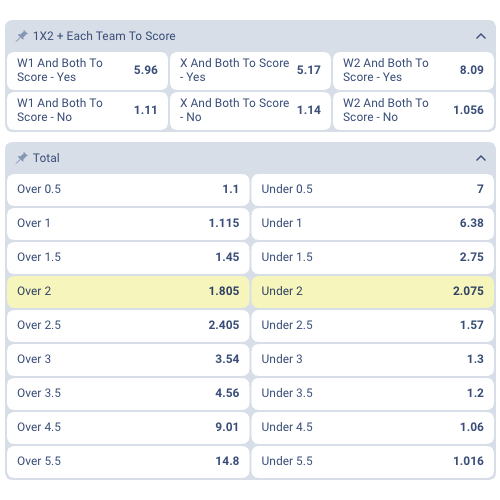
Total goals | Goals from both sides together, over or under the posted line | The line drops as the minutes run out |
Asian handicap | One side starts the coupon with a goal advantage | Moves as soon as the game turns one-sided |
Both teams to score | Whether Rad (Youth) and Avala 1939 (Youth) both find the net | Closes once the answer can no longer change |
Next goal | Which side scores next, or nobody does | Settles at the next goal or at the whistle |
Corners and cards | The count of corners or cards in a half or across the game | Runs while play continues, pauses at the break |
Correct score | The exact scoreline at the end of the match | Swings hardest in the seconds after a goal |
One position per fixture keeps the reasoning traceable; stacking several bets on the same meeting makes it impossible to tell afterwards which idea actually worked. A market taken because it matches what is happening on the pitch lasts longer than one taken out of habit, and the lines above are read against the clock.
What moves the price right now
A goal inside the opening quarter of an hour redraws the match: the side in front drops a line deeper, the other pushes up, and the space that appears feeds the next-goal market as much as the over. Each of those turns reaches the coupon within seconds. Holding a lead also eats the clock: throw-ins take an age, goal kicks stretch out, the ball spends longer outside the pitch and the goals total suffers for it. One goal shifts the totals line, the handicap and the result price in the same refresh.
A foul inside the area punished with both a penalty and a red turns a match on a single action: a goal all but given, and a man missing until the final whistle. A red card leaves a side a player short for the rest of the game, and the market treats the remaining minutes as a different match. The second period frequently starts with a different shape from the one that finished the first, a defender fewer, a wide man more, and the balance of the game redrawn. The two halves seldom carry the same rhythm, and the second is where the goal lines usually get decided.
On the last corner of a match slipping away, the goalkeeper walks up into the opposite box, and the danger runs both ways because the net behind him stands empty. Corners and free kicks near the area are the shortest route to a goal when a side cannot build through the middle. Ahead of a congested week, the team sheet released an hour before kick-off can show half a different side, and the price set days earlier no longer matches what walks out. Fresh legs after the hour change the pressing distance, and the goal markets answer within a few minutes.
Match statistics: what they show and what they hide
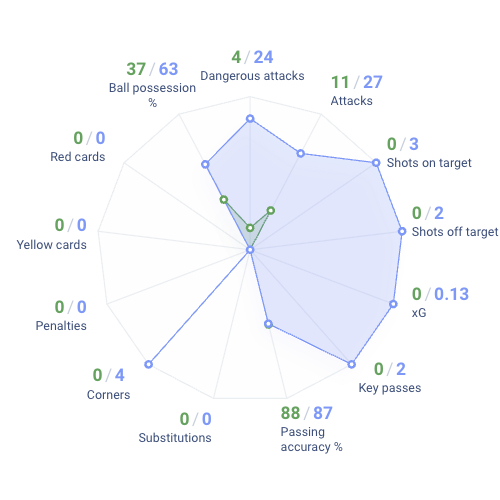
Possession on its own says nothing: passing the ball across the front of a low block without ever shooting fills time, it does not bring a goal any closer. Possession, shots, shots on target, corners and dangerous attacks describe pressure, and pressure is what the goal markets price. Corner counts reward sides that cross often and sides chasing a scoreline late on, so the figure measures a style and a situation rather than dominance. A side can hold the ball for an hour without troubling the keeper, and the counter still reads in its favour.
The height of the defensive block depends directly on the goalkeeper: one who sweeps far from his line lets the defenders push up, while one who stays home forces the whole team to sit deeper. One goalkeeper in form wipes out the gap the shot count promised. Staying unbeaten for a long time describes what has already happened and holds no promise for the meeting ahead; every such run ends somewhere, usually without any warning sign. Recent form of Rad (Youth) and Avala 1939 (Youth) explains the opening prices, then loses weight with every minute the fixture actually plays.
Placing a bet while the game is live
Everything is designed to be fast and free of hassle. The route is identical on a computer and on a phone.
A tab left open for hours deserves a reload before you trust it, since finished meetings drop out of the list while fresh ones appear and a frozen screen shows neither. The football list in live football holds the fixture in place from kick-off to the final whistle.
Tap the price of the market you want. Tabs at the top of the slip move the same selections from one bet type to another, sparing you the job of rebuilding the list line by line. The coupon stores that figure as it stood at the tap.
Enter the stake in dirhams and check the return the coupon calculates.
Prices can move while the slip sits open; depending on the setting chosen, validation goes through at the new figure or stops to ask again, and that preference is picked beforehand, not afterwards. A price that moved while you were typing comes back for acceptance instead of being swapped in silently.
Follow the ticket in the list of open bets, where settlement appears once the result is official.
Where the option is offered, a running bet can be closed early for the sum shown at that moment, a judgement about the minutes still to come rather than the final score.
Prematch and live on the same fixture
In play you take the price as shown or watch it move; ahead of the start you keep the right to refuse it and wait for the board to come to you. The prematch line opens days ahead on the football line and closes the moment the referee starts play. Following one fixture across several days shows how far the opening price sits from the price on the eve: the same meeting, two different pictures. A price taken early carries the risk of team news; one taken in play carries the risk of the next attack.
Before the game the work rests on tables and past meetings, while live it is the counters ticking in real time that steer the stake. A position opened before kick-off and an addition made twenty minutes in can sit in the same ticket list. In-play football makes every attack matter, as odds rise and fall with each shot and counterattack. The board stays open to the last action, and the rest of the live section works on the same clock for every other sport in play.
Money, app and help in Morocco
Nothing forces you to discover a charge after the fact, since the form displays it before validation and the figure that will really land is known at the moment of pressing. An account held in Morocco is funded and settled in dirhams, so no conversion stands between the deposit and the stake. The moment a request is sent, the amount leaves the available balance and can no longer feed a betting slip while the operation is being decided. A withdrawal is requested from the same cashier screen, which lists the methods open for it at that moment.
Method | What it is | Currency | Suits a bettor who |
|---|---|---|---|
CIH | Moroccan bank, cards and transfers | MAD | already banks there and pays from the banking app |
Attijari | Moroccan banking network with branches nationwide | MAD | holds a card from the same group |
Al Barid | Postal banking service | MAD | uses the post office network every day |
Lbankalik | Everyday Moroccan banking service | MAD | handles the account mostly from a phone |
Cash Plus | Cash payment network with staffed counters | MAD | pays in notes at a counter, without a card |
A slip in progress survives a dropout: the connection comes back, the selection is still sitting there, and nothing has to be rebuilt from scratch. A phone left on the fixture screen shows the same prices as a computer, and the mobile app page sets out what the download asks for. A single download puts the entire platform on your screen. A goal alert lands faster than a manual refresh, which decides whether a market is still open when you reach it.
Evenings with a big fixture on concentrate the requests, and a question that can be asked in the morning comes back noticeably faster. A stake that did not go through is easiest to raise from inside the account, where the ticket carries its own number. Account access, verification or a lost password: the support desk works through each of these cases one step at a time. The reply arrives in the same window, and the thread keeps the history.
After the final whistle
A filter by discipline trims the list down to what matters: the competition you follow stays alone on screen, without the other events running at the same time. Settlement runs against the official result, and the ticket moves from the open list into the history. The overview row carries only the headline prices; opening the fixture unfolds the rest, from totals to period markets. The competition carries on, and the next round for Rad (Youth) and Avala 1939 (Youth) appears on the same list within hours.
Adding a market to the slip takes seconds, from the match winner to the totals. A game still in play keeps its board alive to the last kick, and the list rolls on to the next kick-off as soon as this one closes.